
Which rules apply to auto dialing?
Auto dialing means the PBX calls a list of numbers one after another and either plays a recorded announcement or connects the answered call to an agent. If the call promotes goods or services, makes a sale or announces an offer, it counts as a commercial electronic message in Turkey. Such messages are governed by Law No. 6563 on the Regulation of Electronic Commerce and the Regulation on Commercial Communication and Commercial Electronic Messages published in 2015.
This guide sums up the main points to watch when preparing a campaign. This guide is for general information only and is not legal advice; check with your legal adviser and the current legislation before a campaign.
What is a commercial electronic message?
A commercial electronic message is a message with data, voice or video content sent for commercial purposes by electronic means such as telephone, call centres, automatic dialling machines, text messages or e-mail. So a bulk voice call with a recorded announcement and a sales call made by an agent can both fall into this scope.
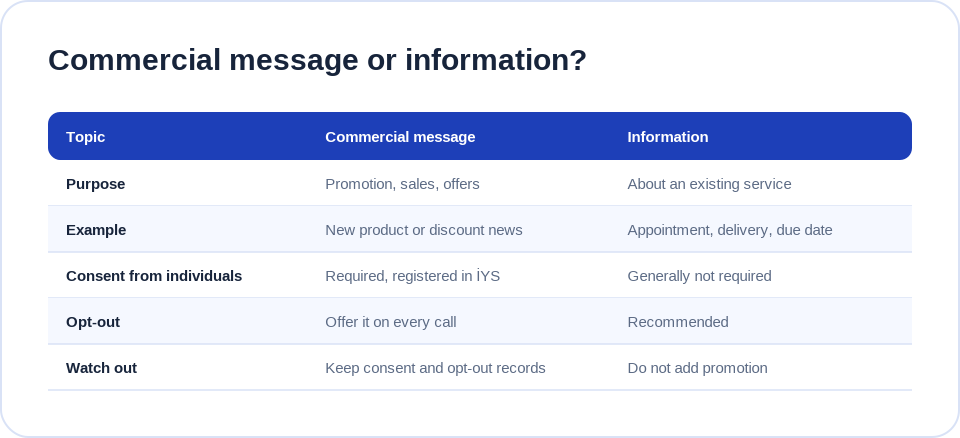
What matters is the content of the call. A call announcing a new product, discount or offer is a commercial message; an appointment or delivery notice about a service the customer already uses is generally treated as information.
When and how is consent obtained?
Before commercial calls to individuals you need explicit consent. Consent can be given in writing or electronically; what matters is that you can prove it:
- The consent text should state clearly which channel (voice calls, SMS, e-mail) will be used.
- The name and contact details of the person giving consent should be recorded.
- When and how consent was given (web form, shop, phone) should be kept.
- The burden of proving consent lies with the business sending the message.
- Consent records should be kept for a period after the consent ends.
Calls to traders and tradespeople
If the recipient is a trader or tradesperson, no prior consent is needed for commercial messages. But these recipients can always opt out, and traders who do should not be called again. Even when calling a business customer list, you need to offer a way to opt out on every call and keep track of opt-outs.
What is İYS and what do you need to do?
The Message Management System (İYS) is the national system where consents and opt-outs for commercial electronic messages are held in one place. Businesses sending commercial messages register with İYS and upload the consents they collect, and citizens can see and withdraw their consents in İYS.
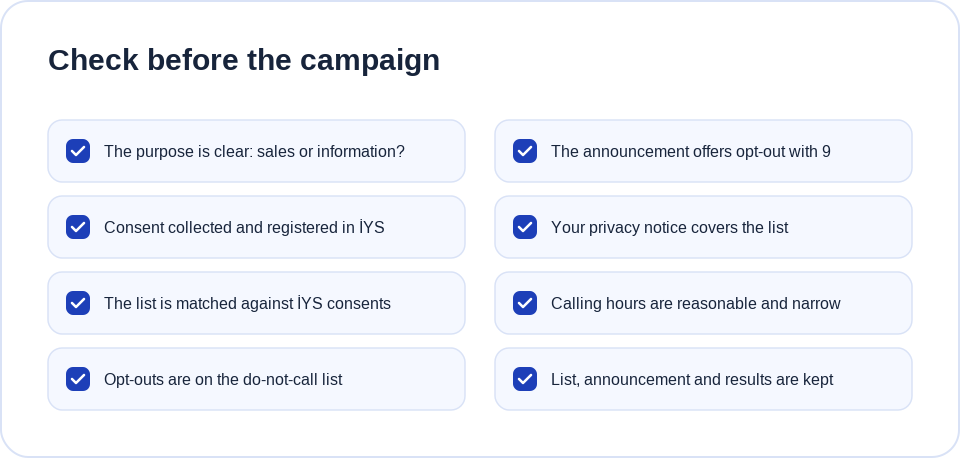
In practice, follow this order before a campaign: compare your list with the voice call consents in İYS, remove numbers without consent or with an opt-out, and start the campaign with the rest. Add opt-outs to the do-not-call list in your PBX as well.
The right to opt out: a free exit on every call
Every commercial message must give the recipient a free and easy way to refuse further messages. On voice calls, the simplest way is a clear sentence in the announcement, such as “Press 9 if you do not want to receive these calls.”
Once an opt-out arrives, messages should generally stop within three working days. The number should be removed from all your campaigns and skipped in newly uploaded lists too.
Informational calls
Reminders and notices about a subscription, membership or ongoing purchase, such as appointment reminders, order or delivery status, payment due dates and service interruptions, generally need no consent for commercial messages. Do not add promotion to these calls: a sentence like “There is also 20 percent off this month” can turn the call into a commercial message. Running informational and promotional calls as separate campaigns also makes record keeping easier.
KVKK and privacy notices
Phone numbers and names are personal data, so using a list also means complying with the Personal Data Protection Law No. 6698 (KVKK). State in your privacy notice why the numbers were collected and use the list only for that purpose. Do not call from lists bought elsewhere or collected for an unclear purpose. If you record calls, tell people at the start of the call.
Related pages: Call Recording and KVKK: A Business Guide
Calling hours and frequency
Calling people when they are resting leads to complaints and opt-outs. Prefer weekday daytime hours, do not call the same person again and again at short intervals, and keep retries low. Suitable hours may vary with your sector and the current rules; if unsure, choose a narrower window.
Keeping records
In a complaint or an inspection you need to show the person’s consent and what the call said. For every campaign, keep the list used, the announcement text and audio file, the campaign dates and the per-number results. Also record when each opt-out was received and when it took effect.
How TekSantral’s tools help
TekSantral’s auto dialer does not take the legal responsibility off you, but it makes the rules easier to follow:
Opt out with 9
Anyone who presses 9 during a voice broadcast is added to the do-not-call list automatically and is not called in any campaign.
Do-not-call list
You can add opt-outs from İYS by hand, by CSV file or through the API, and download the list as CSV.
Hour limits
Calls are only made between 08:00 and 21:00, on the days and within the hours you choose.
Consent box
A campaign cannot be saved until you tick the box accepting responsibility under Law No. 6563 and İYS.
Result records
Each number’s result, attempt count and last call time can be downloaded as CSV and kept in your records.
Related pages: Auto Dialer: Bulk Voice Broadcast Calls